
What a Pomona Resident Lookup Confirms
A resident lookup can confirm a record relationship, an event, or a public role. It cannot certify that every source refers to the same person without matching details. Start with the most specific clue available: a case number, license number, corporation number, document number, exact date, or known address. Then compare names, geography, dates, and roles before drawing a conclusion.
| Record | What It Confirms | Where | Access |
|---|---|---|---|
| Assessor parcel | Address-to-parcel relationship, AIN, characteristics | LA County Assessor | Free address or AIN search; owner name withheld online |
| Recorded deed | Named grantor, grantee, date, legal land identity | LA County RR/CC | Office, mail, fax, or copy route |
| Voter status | Entered voter's current registration status | LA County RR/CC | Private four-field self-check |
| Court case | Party role, case number, courthouse, events, disposition | Los Angeles Superior Court | Case-family limits and product fees |
| Vital record | Birth, death, marriage, or dissolution event | RR/CC or CDPH | Authorized or informational copy rules |
| Business or license file | Public role, number, status, address, filing history | California SOS or DCA | Free index with role limits |
| Probate file | Decedent, petitioner, heirs, filings | Los Angeles Superior Court | Public file except restricted material |
Other official lookups answer narrower questions. The LASD Inmate Information Center covers current or recent county custody; CDCR covers state prison custody; California Megan's Law is a statutory public registry with use restrictions. None is a complete criminal-history or current-residence source.
Build a Two-Source Pomona Match
The safest resident lookup protocol begins with a stable identifier and ends with two independent matches. A middle initial, suffix, birth date, case role, license number, document number, or exact historical address is more useful than a common surname. Compare the date range and geography, then ask whether the record describes ownership, a business role, a court party, a registrant, or a household entry.
- Write the name exactly as it appears, including initials, suffixes, compound surnames, and variant spellings.
- Choose the record that answers the question, such as a deed for a recorded owner or probate file for an heir lead.
- Save the stable number, date, location, and party role before opening a second source.
- Compare the second record without treating age, relatives, or a shared street as conclusive by itself.
- Ask the custodian for a certified or corrected record when the result matters.
A business filing can identify an agent or principal, while a license can identify a public professional record. A court index can identify a litigant, while a deed can identify a grantee. The word “resident” should never erase the source's actual role.
- Namesake
- A different person who shares a name; stable numbers and dates help separate the records.
- Docket
- The court's running record of case filings, events, hearings, and orders.
- Index
- A finding aid that points to a file or image but may not prove every detail.
- Certified copy
- A copy the custodian formally certifies, subject to the record's eligibility rules.
- Disposition
- The court's recorded outcome or current status for a case or event.
Pomona Lookup: Court Roles
Pomona cases route through the Superior Court of California, County of Los Angeles. The court's Find a Case landing page separates civil, criminal, family, probate, and other products. A party name is a lead. The case number, filing courthouse, filing date, party role, event history, and document availability make the lead useful. A resident lookup that stops at a name can attach a real case to the wrong person.
The paid civil index searches a last and first name or company. Documented coverage is probate, family, and unlimited civil from 1983, limited civil from 1991, and small claims from 1992, with daily updates. A guest name search costs $4.75 even without a match. Probate images begin January 1, 2001. Older records can route to the Archives and Records Center, with mail retrieval taking eight to ten weeks.
The court's landing screen shows why case type matters in a Pomona resident lookup.
Open Los Angeles Superior Court case access before choosing a product.
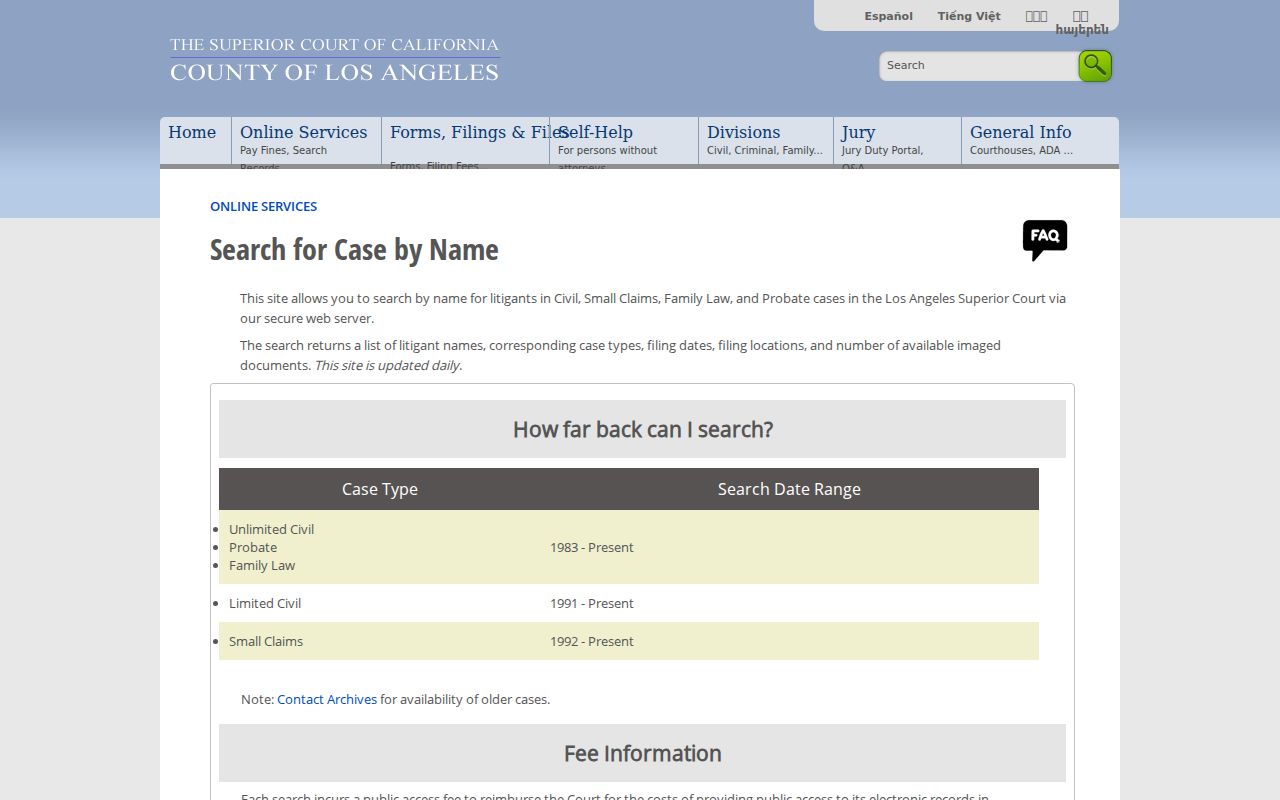
Use the role and case family to decide whether the name hit belongs in the next verification step.
Read a Pomona Lookup Result
The civil index and related case products use different modes. A case-number route generally needs the court-formatted number and filing courthouse. A name route needs the party name and may offer filing-date or courthouse filters. Family and confidential records have tighter access. Images may be available online, at a clerk terminal, by counter request, or by copy order depending on the case family and date.
| Search Field or Result | Type | What It Does | Limit |
|---|---|---|---|
| Case Number | Text | Finds a known case in number mode | Must use the court format |
| Party Name | Text | Searches surname, first name, or company | Namesakes and role confusion |
| Filing Date Range | Date pair | Narrows a common name where offered | Product-specific option |
| Courthouse or District | Dropdown | Tests the Pomona assignment clue | Not a residence proof |
| Case Type | Tab or product | Separates civil, criminal, family, and probate | Different access rules |
A Pomona court result can expose a useful sample inventory:
- Case number, title, filing date, case type, courthouse, and judicial district
- Party names, party roles, event dates, hearings, and disposition or status
- Register-of-actions entries and document links when the case family permits them
- Minute orders or image counts, with paid access or clerk retrieval where required
A typical public register of actions can show case number, title, filing date, case type, courthouse, party names and roles, event dates, hearings, disposition or status, and document entries. Actual images depend on the case family, date, fee, and redaction rules. Sealed, juvenile, adoption, confidential financial, and protected address material is not a general search result.
Note: A no-hit result says only that the selected product did not find the name under its search rules.
Pomona Lookup License Numbers
California's professional and business indexes are useful namesake controls. The DCA search commonly filters by board or bureau, license type, business name, last name, first name, license number, city, and county. A result can lead to status, issue or expiration dates, public address, and discipline documents. Record the license number and the “as of” date.
SOS bizfile adds entity name or number, entity type, status, formation jurisdiction and date, principal or mailing address, agent for service, and filing history. Open older Statements of Information because former agents and addresses can be visible in earlier filings. A registered-agent address is service information, not residency evidence. The State Controller's unclaimed-property search can add a reported owner name, city, holder, and property type, but a claim needs proof.
Use a professional record or business filing to separate two people, not to create a private address profile. If the identity question is about custody, use the official LASD or CDCR locator for its narrow system rather than treating an absent result as proof of anything broader.
Pomona Vital Record Copies
Birth, death, and marriage research in Pomona goes through Los Angeles County RR/CC for county events or the California Department of Public Health for statewide services. California distinguishes an authorized certified copy from an informational certified copy. Authorized copies require a qualifying relationship or category and usually a sworn statement. Informational copies carry a legend and cannot establish identity.
| Birth, 2026 CDPH fee | $31; verify the selected county or state application route |
|---|---|
| Death, 2026 CDPH fee | $26; fee may remain due as a search fee |
| Marriage, 2026 CDPH fee | $19; confidential marriage access is narrower |
| Dissolution certificate | $18 at CDPH for the documented 2026 schedule; the court holds the decree |
| Access law | Health and Safety Code §§103526 and 103526.5 control authorized-copy classes |
Prepare the registrant's full name, event date and place, parents or spouse details where needed, applicant relationship, copies requested, signature, payment, and notarization when the mail route calls for it. Online, mail, and in-person options vary by product. Use the California vital-record applications and current processing page before promising a date.
Find a Pomona Heir Through Probate
Probate is one of the more focused ways to connect a deceased Pomona resident to family and property history. A public probate lead may identify a decedent, petitioner, case number, events, heirs or devisees, and filings. The case still needs a role and document check. A petitioner is not automatically the sole heir, and a name in a notice is not proof of a current address.
Search the Los Angeles Superior Court probate product by name or case number. Read petitions, notices, inventories, and final distributions where access permits. Match the decedent to an obituary, cemetery roster, directory entry, deed, or known date. Sealed filings and confidential details remain closed. The same two-source rule applies even when the probate record looks precise.
Spadra Cemetery's 1948 burial-order plat book, held by the Historical Society of Pomona Valley, is a useful local endpoint for death research. It can bridge a name and burial place, not prove the survivor's present location.
Pomona Adoption Record Channels
A birth-family question needs an official path rather than a public name index. California adoption information and mutual-consent channels administered through the appropriate state program can control what an adopted person, birth parent, or relative may request. Public vital indexes cannot override sealed or confidential adoption records, and a missing public entry is not evidence that an event did not occur.
Prepare the relationship, dates, names at the time of the event, and any agency or court information already known. Ask the official program what eligibility, consent, identity proof, and forms apply. A Pomona library genealogy collection, census, newspaper, or directory can supply historical context, but it cannot open a protected file.
Note: The right result in a family search may be a protected-record explanation and a lawful referral, not a name or address.
Safe at Home Protects Pomona People
California's Safe at Home Address Confidentiality Program serves qualifying survivors and specified participants. It supplies a substitute mailing address and confidential mail forwarding in covered interactions. Regulations changed effective April 1, 2025. A resident lookup must not try to reconstruct the protected address from deeds, voter material, court filings, social clues, or other records.
California privacy law also protects selected voter identifiers and restricts DMV residence data. The California Consumer Privacy Act and California Privacy Rights Act provide rights that can include access, correction, deletion, and limits on sale or sharing, subject to scope and exceptions. Those rights do not delete government originals. The state Delete Request and Opt-out Platform launched January 1, 2026 for qualifying California residents and registered data brokers.
The California Megan's Law registry is a separate statutory public resource with search and map modes, offense and identity fields, exclusions, and anti-misuse warnings. Its result is a registry record, not a complete resident lookup.
Review the California Megan's Law search only for its stated public-registry purpose.
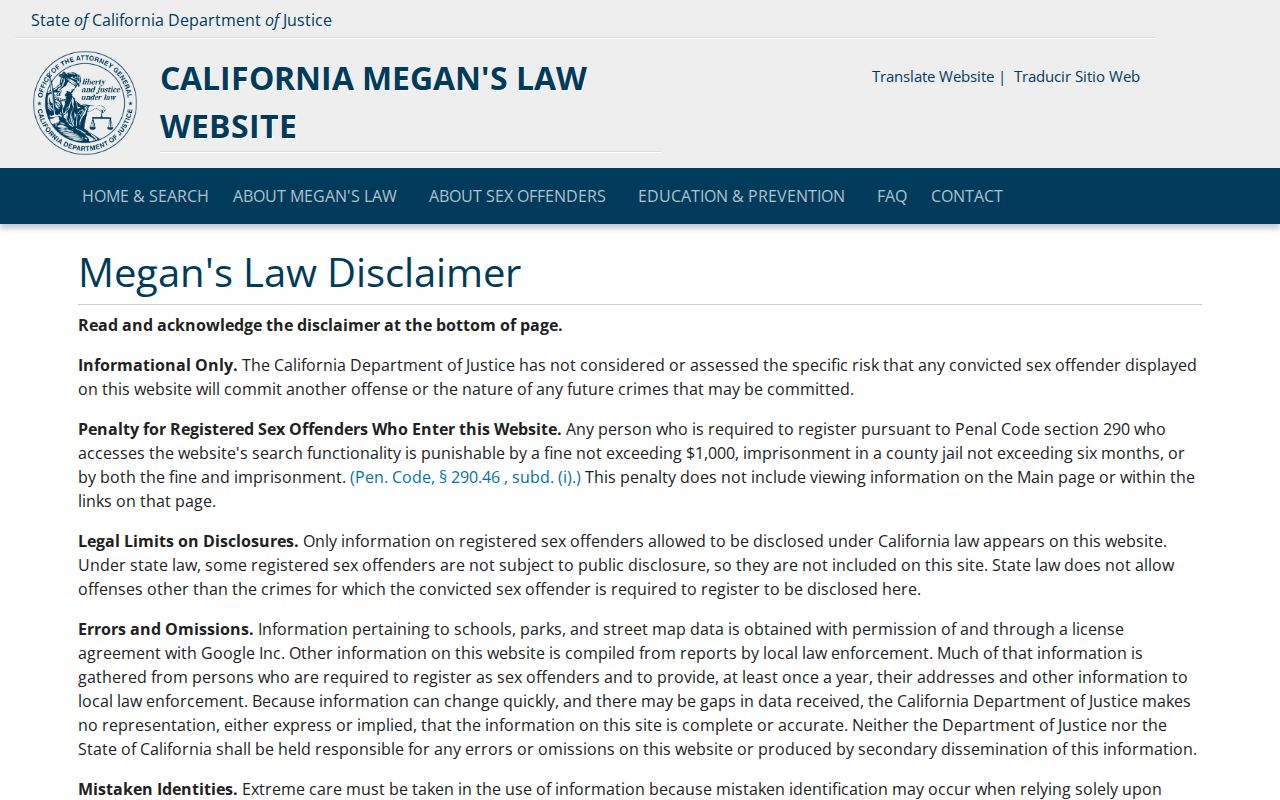
The registry screen reinforces the rule that a narrow official result must not be broadened into a general profile.
Legal Limits on a Pomona Resident Lookup
California records can be used for lawful personal research, genealogy, estate and heir work, civic review, and safety-aware verification. Access does not authorize stalking, harassment, threats, impersonation, doxxing, or evasion of a protective order. Penal Code §646.9 and civil restraining-order remedies address stalking and harassment. Elections Code §2194 restricts voter-data uses, and federal law limits DMV record access.
Lawful personal use. A Pomona resident lookup is a record-finding aid, not permission to expose a protected person or pressure a custodian. Verify with the office that holds the record and stop when the law or safety program requires a stop.
When a record is sealed, confidential, redacted, or simply absent from a product, preserve that boundary. A careful lookup reports what the source says, what it does not say, and which official route can answer the next lawful question.