
Sources for Previous Residents of Pomona
The era map below separates ownership, occupancy clues, household records, and structure history. No one source lists every person who passed through an address. Recorded deeds are the land spine. Pomona city directories and census schedules add named households. Sanborn maps show structures and uses. Permits date work. Newspapers, obituaries, probate, and cemetery files can close a family trail.
| Source | Years It Covers | Where Held | What It Shows |
|---|---|---|---|
| Recorded deeds and index books | 1850-present | LA County RR/CC, Norwalk | Owners, grantors, grantees, dates, legal description, return data |
| Pomona directories | 1896-1948 digitized run; known editions through 1951 | Pomona Library and digital repositories | Listed adults, addresses, occupations, spouse clues |
| Federal census | 1870 onward for established Pomona-area households; public through 1950 | NARA, FamilySearch, library databases | Household members, ages, relationships, occupation, tenure |
| Sanborn maps | Available editions; exact Pomona years need sheet confirmation | Library of Congress and libraries | Footprint, material, use, outbuildings, old street numbers |
| City permits and planning | City-era files; exact digitized start not located | Pomona departments or CPRA request | Construction or alteration dates, applicants, contractors |
| Newspapers, obituaries, probate | Archive-specific | Library, court, society, and newspaper holdings | Deaths, kinship, former addresses, social context |
The table is an order of work. Start with the current parcel and acquisition deed, then choose the household source that fits the date. Previous residents can be owners, listed adults, family members, or people named in an event, and those categories should remain distinct.
Start with Today's Pomona AIN
The current address is the bridge into the past. Search the Los Angeles County Assessor by street address or AIN, save the situs, use, building and roll data, and record tract or lot clues. If the address fails, try nearest cross streets, a map click, or an alternate corner or multi-unit format. The public portal does not supply an unrestricted owner-name search, so the parcel key matters more than a guessed name.
A deleted parcel can still leave a history clue. The Assessor's deleted-parcel detail route may retain status, create or delete dates, and other parcel identifiers that help connect an old AIN to a new one. Parcel detail ordinarily updates weekly except during the July to late September freeze, while the mapped display uses an annual snapshot.
The deleted-parcel capture shows why a missing current result does not end a previous-residents search.
Review the LA County deleted-parcel example alongside the current address.
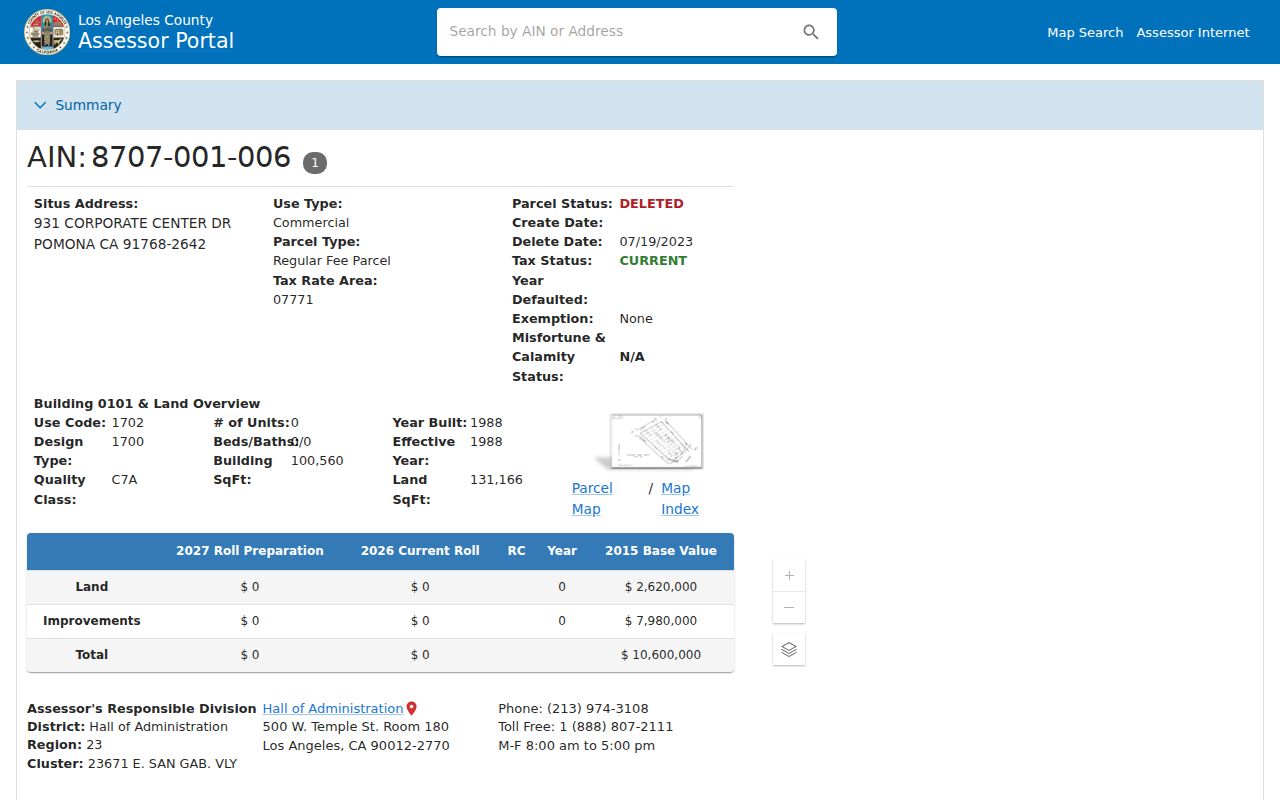
Keep the old AIN, new AIN, situs, tract, and lot together before moving into the deed index.
Trace Past Owners Through LA County Deeds
Los Angeles County RR/CC holds recorded instruments from 1850 to the present, but the public route is not a street-address or APN web index. A deed search needs party names, title or document type, year or range, and other identifying facts. The county offers Norwalk viewing by appointment and copy channels through mail, fax, or online ordering as available. Phone requests are not accepted.
- Use today's AIN and parcel clues to identify the acquisition deed and current grantee.
- Read the deed for grantor, grantee, recording number, recording date, return address, and legal description.
- Search the prior grantee or grantor with the tract and lot description, not a name alone.
- Repeat the transfer step until the index, book, or legal description reaches the target era.
- Switch to directories, census, newspapers, probate, or cemetery sources for household members.
The county's mail request form explains the facts needed for a search and the up-to-20-working-day processing statement.
Read the RR/CC mail-search route before sending a prior-owner request.
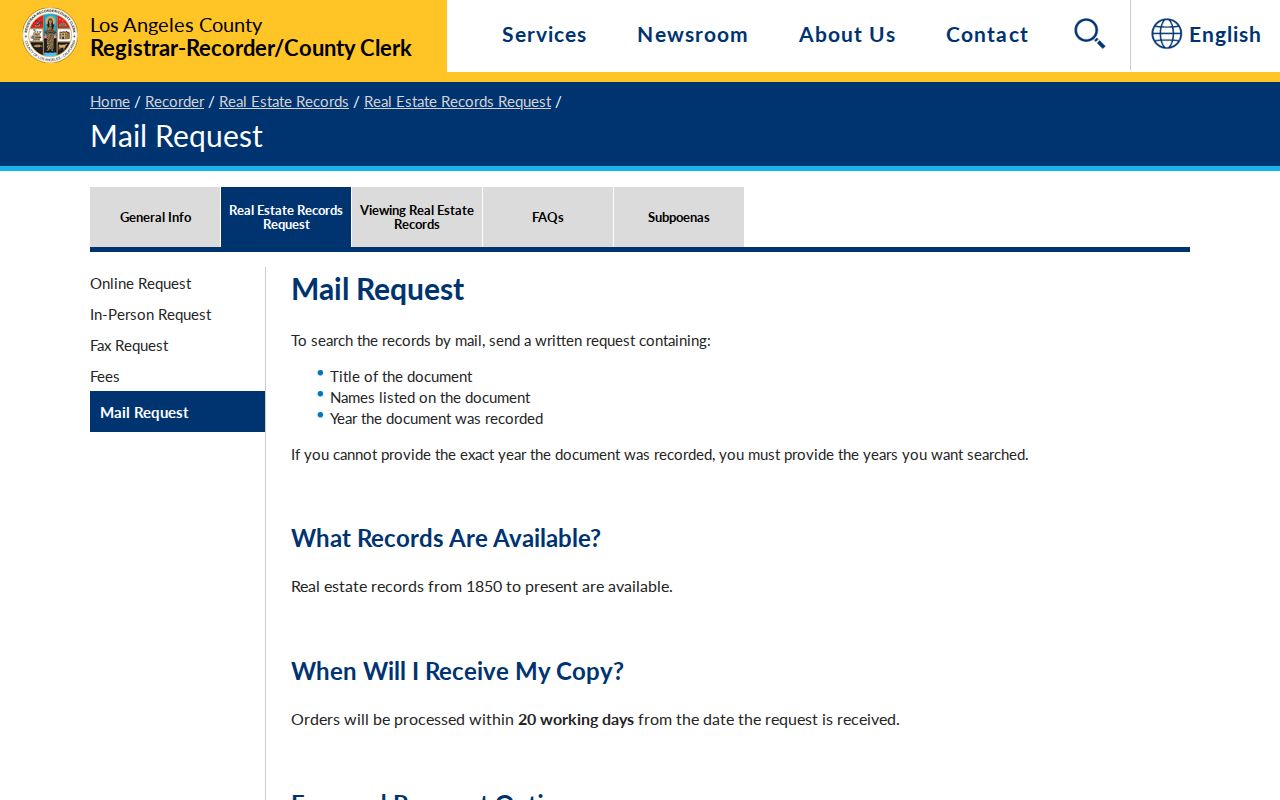
A written request works best when the parcel key, party names, document type, and date range are already narrowed.
Copy and certified-copy prices are separate from the search itself. The county's fee page documents a name and year search, plain and certified page charges, expedited UPS, and card handling, all subject to current verification.
Check current recorder search and copy fees before calculating a past-resident project.
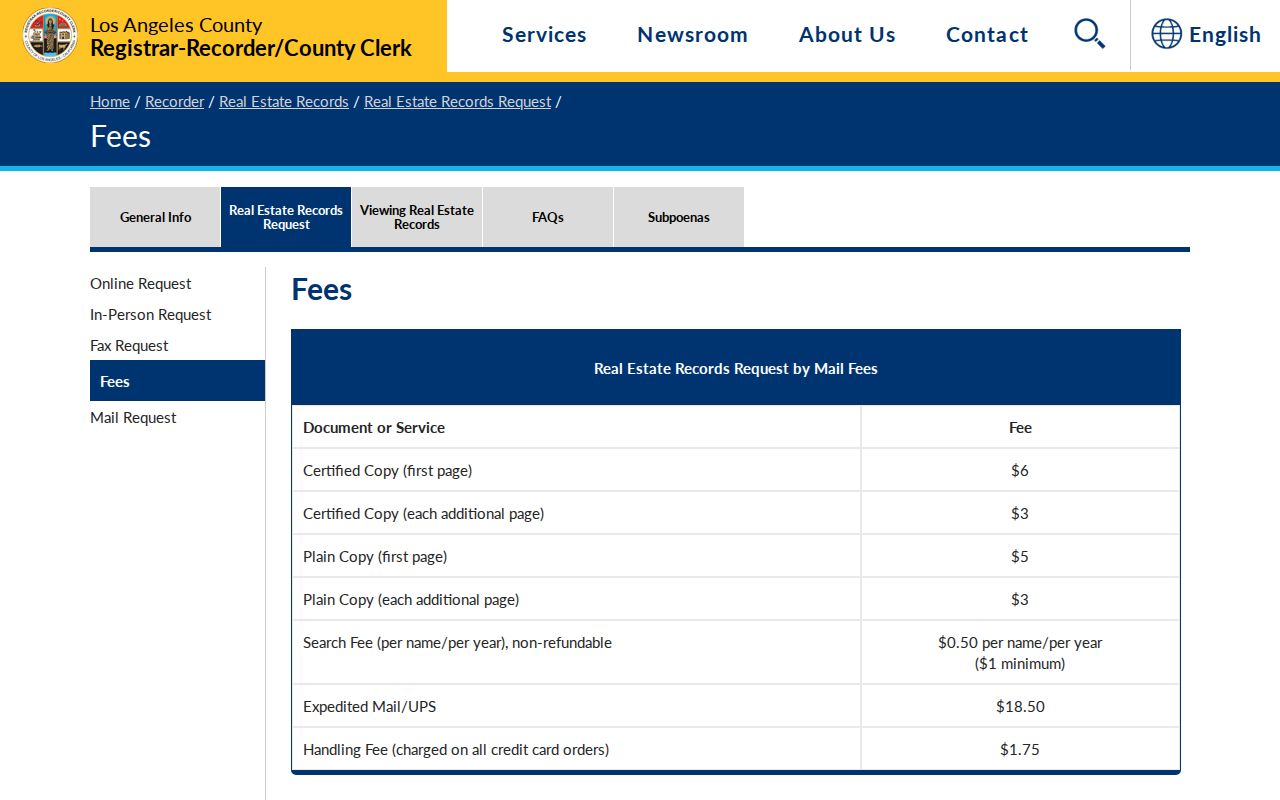
The fee schedule tells the cost of the chosen document route; it does not make a street-address index available online.
Keep Pomona's Legal Description Constant
Addresses change. City labels change. Tracts, lots, and legal descriptions are safer bridges across those changes. The Assessor's property boundary description can contain internal lot or tract detail, but the county says it is not the deed's actual legal description. Obtain the acquisition deed when the chain depends on land identity.
Keep situs, mailing address, AIN, tract, lot, recording number, and date in separate fields. A mailing address may point to a fiduciary or another delivery choice. A matching mailing and situs address may suggest a connection but does not prove the owner lived there. The previous-residents trail should not turn an ownership transfer into a household claim.
- Grantor
- The party transferring an interest in a recorded instrument.
- Grantee
- The party receiving the recorded interest.
- Chain of title
- A linked sequence of transfers for the same land.
- Legal description
- The recorded land identity that controls over a shorthand address.
- AIN
- The county parcel identifier used to keep map and assessment clues joined.
Note: The legal description is the safer bridge when a street number, city label, or parcel identifier changes.
Old RR/CC Books Need Patience
Los Angeles County's older recorder indexes include handwritten loose-leaf logs. A county preservation statement described more than 1,500 books in fair-to-poor condition, with acidic paper, tears, broken binders, and later handwritten amendments. That preservation story changes how previous residents should be searched. Exact-name matching can miss a marginal addition, an old spelling, or a handwritten correction.
Use the Norwalk office or records staff for the index and copy route. Bring the AIN, document number, year, party names, and legal-description clues already gathered. If an online result is absent, that absence may reflect the county's decision not to publish a broad web index, not a missing deed.
The recorder's old books are a search environment, not a clean database. Photograph or transcribe every amendment and page reference that changes the chain.
Read Pomona Directories from 1896
Pomona's city directories supply the household layer after the deed chain identifies an address or era. Milliken's City Directory of Pomona begins the documented trail in 1896 to 1897. The library policy describes directories from the late 1890s through the present, with 1896 to 1945 microfilmed. Known individual editions include 1896, 1898, 1903, 1907, 1909, 1911, 1914, 1916, 1919, 1922, 1926, 1931, 1940, 1945, 1948, and 1951.
Search alphabetically, copy the exact address and occupation, then turn to a street or criss-cross section. A documented 554 W. Center Street household appears across eleven editions from 1907 through 1951, while other named occupants appear in earlier years. The example proves the method, not continuous occupancy. Moves, death, omission, and publication lag remain possible.
The full collection method and access details are in the Pomona city directory collection reference.
Pair Pomona Addresses with Census
Federal census schedules add the household facts a deed cannot. Public schedules through 1950 can show members, ages, relationships, occupation, and tenure at an enumeration location. Pair the nearest directory edition with the nearest released census. If the address is not written in the same form, use street names, enumeration maps, household members, and tract or lot clues to test the match.
- Copy the directory line and note its edition date, page, address, spouse, and occupation.
- Search the nearest public census and compare the household, ages, relationships, and location.
- Check a directory edition before and after the census year for a move or new household.
- Use newspaper, obituary, probate, and cemetery records when a death or family change is plausible.
A directory is often closer to an annual street view, while the census is a periodic household snapshot. Their mismatch can reveal a move or a publication gap rather than an error.
Use the National Archives census release information to choose the public year.
Sanborn Maps and Pomona City Files
Sanborn fire-insurance maps can date a structure's footprint, material, use, outbuildings, and old street numbers. The Library of Congress collection is a useful discovery route, but the exact Pomona sheet years need catalog-level confirmation. A map can explain why a former address looks different without naming every person who used the building.
Pomona planning and building files add another layer. A permit can date construction or alteration and name an applicant, contractor, architect, or owner. It does not prove occupancy. Use the city system or a narrow CPRA request for an existing file, and name the address, AIN, date range, and record type so the custodian can locate it.
Frasher Foto postcards in the Pomona Public Library add visual context for a building or street, while the Progress-Bulletin archive can connect a place to a death, club, marriage, or former address. Both are supporting trails. The deed, directory, census, or court custodian remains the source for the fact that record actually establishes.
For map discovery, use the Library of Congress Sanborn map collection and then confirm the sheet, city, and year.
Past Households from Several Sources
Previous residents are best reconstructed as a layered story. The deed chain tells who received land. Directories show listed adults and occupations. Census schedules show households. Obituaries, probate, and Spadra Cemetery records can explain death, kinship, or a move. Newspapers can add a former address or social event, but a family clue still needs a source check.
House-history limit. A prior-owner name is not a list of every person who lived at the address. Use previous residents evidence for lawful family history, property history, estate work, and local research, and stop at protected or confidential records.
When the trail ends, state why: a missing edition, a closed file, a handwritten index, an unconfirmed Sanborn sheet, or a record that does not identify occupants. That transparent gap is more useful than a confident guess about who lived there before.